
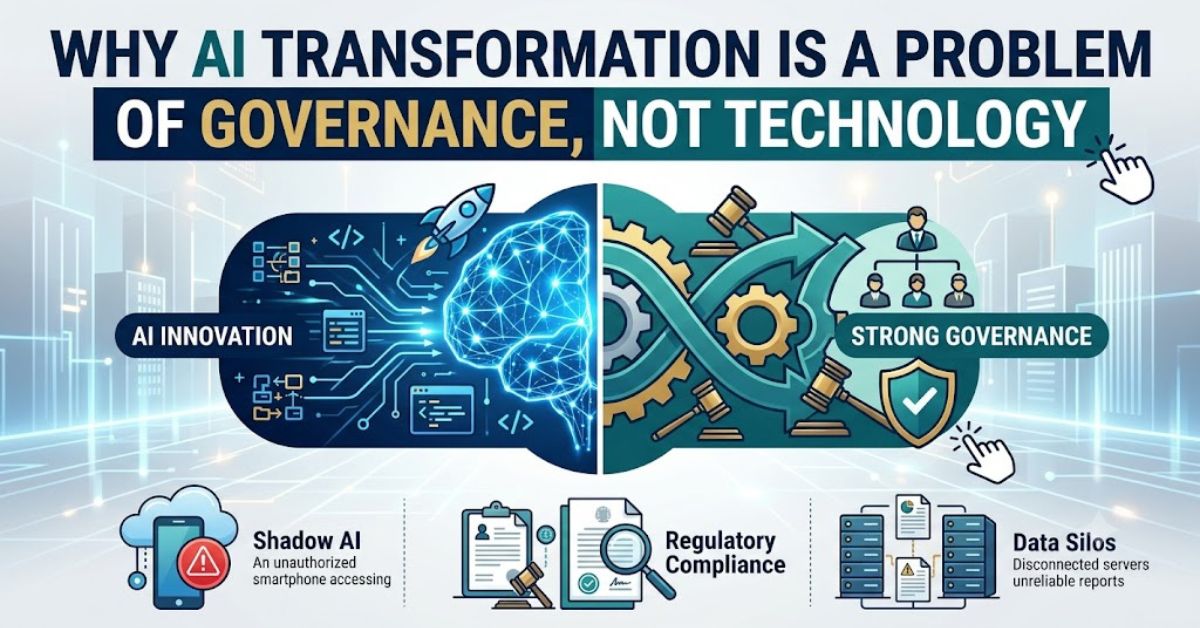
Many businesses are currently spending massive budgets on artificial intelligence. Corporate leaders naturally expect these advanced tools to automatically improve workflow speed and increase total profits. However, looking closely at real-world company rollouts reveals a much tougher reality. Most enterprise AI deployments actually fail to hit their original goals. This high failure rate does not happen because the software lacks power. The real issue is that organizations treat AI like a basic IT installation, missing the fact that true ai transformation is a problem of governance.
Why Old Software Rules Do Not Work
Traditional business tools are completely predictable. For example, your standard accounting sheet or CRM database handles data exactly the same way every single day. It does not change its own code or make independent choices without your input.
AI models do not work that way. They adapt and change silently based on the new data they process daily. Because these systems evolve on their own, their final outputs can slowly drift or generate completely unexpected errors over time. Attempting to manage these shifting digital tools with old IT rules leaves companies exposed to sudden operational mistakes.
Where the Risk Hides in Modern Workplaces
The major problem starts when teams deploy highly autonomous AI assistants to handle daily operations without a human checking every step. When a system independently sorts through job applications, alters customer pricing, or transfers corporate data, things get complicated fast. If the tool makes a major mistake, tracking down who is responsible becomes a nightmare.
Without a clear management framework, a dangerous oversight gap opens up inside the business. This oversight gap creates three major operational headaches:
- Unregulated Tools: Employees often log into unapproved third-party AI tools just to hit tight project deadlines. As a result, private company files end up sitting on external cloud servers without security teams ever knowing.
- Heavy Legal Violations: Strict new international laws now mandate thorough risk audits for advanced software setups. Ignoring these compliance requirements leaves businesses open to massive financial penalties.
- Messy Corporate Data: Feeding advanced tools mixed, disconnected files from different departments creates unreliable summaries that internal teams cannot trace or defend.
Moving Toward True Control ai transformation is a problem of governance
Fixing this rollout crisis requires leaders to balance how fast they move with making sure they are watching everything very closely. The people in charge should make sure things do not move slowly so that it hurts new ideas. Corporate leaders should make a plan that says what kind of data is good enough for what each team is supposed to do and that people are always making the final decisions on rollout crisis issues. This plan should help with the rollout crisis. Make sure corporate leaders are doing a good job.
At the end of the day, engineers can build the software, and managers can run it day-to-day. But governance dictates the actual boundary lines. Until companies realize that oversight matters more than raw speed, their digital transformations will continue to stall out.
