
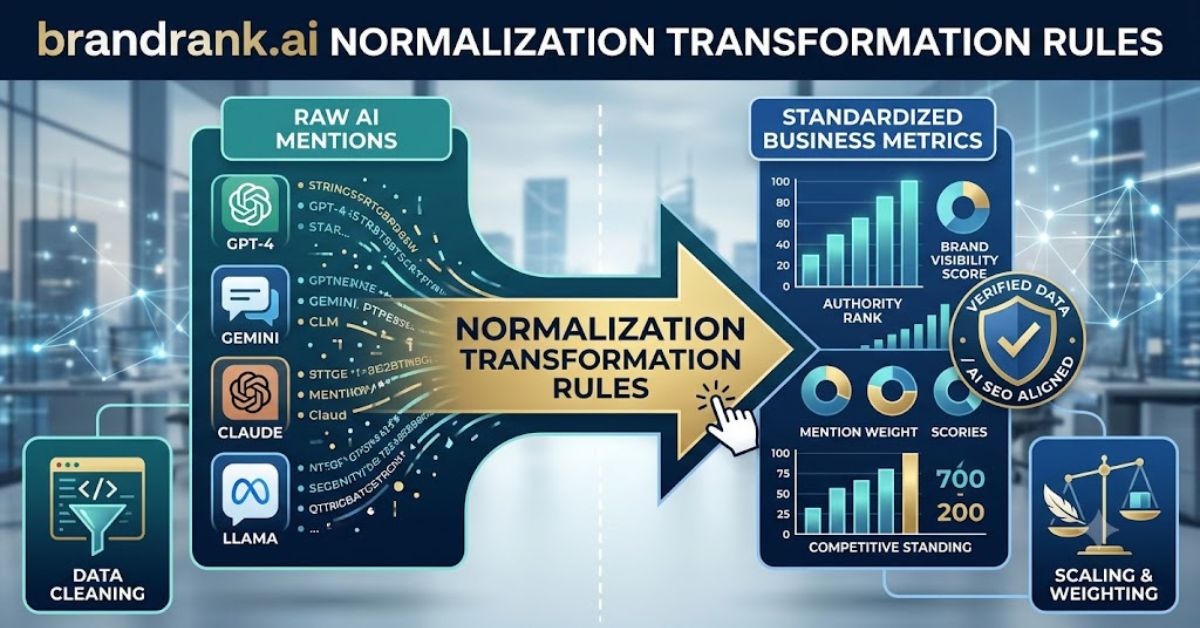
brandrank.ai normalization transformation rules
The digital marketing landscape is shifting faster than ever before. Traditional tracking tools used to focus entirely on standard desktop and mobile keyword positions inside Google search results. However, in the current landscape, modern businesses care just as much about how often large language models and chatbots recommend their services.
This is exactly where new AI visibility frameworks come into play. To provide fair data across completely different systems, engineering platforms rely heavily on backend calculations. Specifically, understanding the exact brandrank.ai normalization transformation rules is essential for any digital marketer looking to track and dominate corporate AI search visibility.
Why Do We Need Standardized Data Rules?
Large language models do not output standard, static search engine links. For instance, ChatGPT might mention your company name inside a long conversational paragraph, while Google Gemini might list the exact same brand inside a clean bulleted table.
Because every AI engine uses a unique layout, comparing raw data directly is impossible. Applying brandrank.ai normalization transformation rules fixes this issue by taking highly fragmented data from various chatbot answers and converting them into a standardized numerical format. Consequently, marketing teams can easily track their overall brand authority across multiple platforms using a single, unified score.
Inside the Data Transformation Process
The system processes raw AI mentions through a structured sequence to ensure the final visibility metrics remain completely fair and accurate. Without this mathematical adjustment, a single long chat response could easily skew a company’s entire marketing report.
The application of brandrank.ai normalization transformation rules operates through three main steps behind the scenes:
-
Text Cleaning and Parsing: First, the algorithm strips away conversational filler words from the chatbot response. It isolates the exact sentences where your brand name actually appears.
-
Contextual Weighting: Second, the rules apply different values based on the mention style. For example, being the top recommendation in a list receives a much higher mathematical weight than being buried at the bottom of a generic summary paragraph.
-
Scaling to a Standard Range: Finally, the system compresses the raw counts into a clean scale, typically between 0 and 100. As a result, tracking changes over time becomes straightforward, regardless of how often a specific AI model updates its core training dataset.
Why Modern Brands Need to Adapt
Ignoring these advanced data cleanup rules leaves companies completely blind to their true digital footprint. If your team only tracks standard Google keyword positions, you are missing the massive audience that now uses AI assistants as their primary research tool.
Ultimately, building a powerful online presence requires mastering how these new systems evaluate and normalize data. By aligning your brand content with the exact data structures that AI platforms scan for, you can systematically lift your organic visibility and secure the top spot in chatbot recommendations.
