
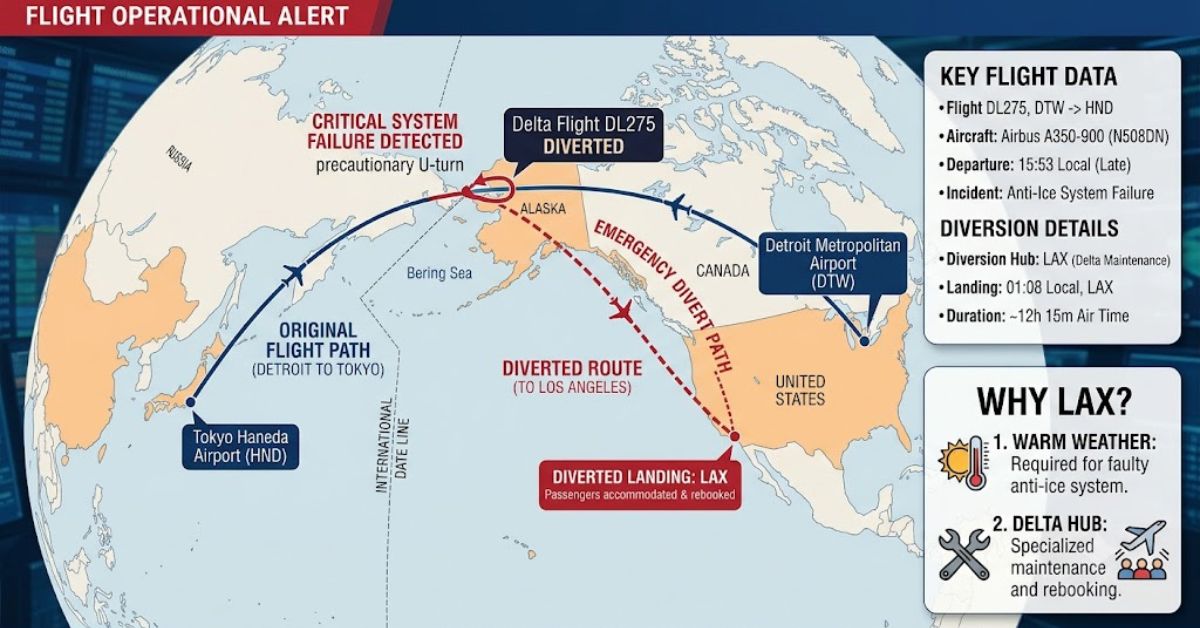
A sudden surge in online search traffic has left travelers wondering about the safety status of a major international route. Thousands of users are actively looking for updates regarding a Delta Flight DL275 diverted LAX event. When a long-haul transpacific flight makes an unexpected turn, social media platforms immediately fill with rumors. However, live aviation tracking logs provide a clear, calm explanation of what actually happened in the skies.
The True Timeline of the Tokyo Diversion
Delta Air Lines Flight DL275 is a regularly scheduled daily long-haul service originating from Detroit Metropolitan Wayne County Airport (DTW). Its final destination is Tokyo Haneda Airport (HND) in Japan. On this specific day, the assigned aircraft—an Airbus A350-900 (registered as N508DN)—departed Detroit running nearly two hours behind schedule due to a late arrival from Europe.
The aircraft proceeded normally along its northern route toward Japan. However, while flying over the freezing waters of the Bering Sea between Alaska and the International Date Line, the operating flight crew detected a system failure. The onboard indicators flagged an issue with the aircraft’s anti-ice protection system. Because transpacific routes require extended flying time over sub-zero environments, fully functioning anti-ice protection is absolutely vital. The crew left nothing to chance and wisely chose to initiate a precautionary diversion.
Why Land at Los Angeles International Airport?
Instead of dropping down into a frozen northern airfield, the airline opted for a massive mid-ocean turnaround, directing the plane toward Southern California. Many people wonder why a plane traveling to Tokyo would choose a Delta Flight DL275 diverted LAX path. The decision comes down to weather and airline infrastructure:
- Warm Weather Requirements: The faulty anti-ice system dictated that the widebody Airbus A350 land in an environment with warm temperatures and clear skies, completely free of freezing clouds or rain.
- Delta Maintenance Hub: LAX serves as a primary hub for Delta Air Lines. It offers the specialized heavy maintenance infrastructure, engineering teams, and replacement components necessary to inspect and service the sophisticated systems of the Airbus A350.
By the time the aircraft safely touched down at LAX, it was 01:08 local time the following morning. The passengers had spent exactly 12 hours and 15 minutes in the air—a flight duration almost identical to the original trip to Tokyo, yet terminating in Los Angeles. Delta customer service teams met the affected travelers at the gate to coordinate overnight accommodation, meals, and rebooking on alternative flights to Japan.
